From Trench to Toy Store: The Combat Bear Who Inspired Winnie the Pooh and Earned Military Honors
An Unlikely Recruitment at a Railway Station
Lieutenant Harry Colebourn was heading to war in August 1914 when his train made a routine stop in White River, Ontario. What happened next would eventually fill children's bookshelves around the world, though nobody could have predicted it at the time.
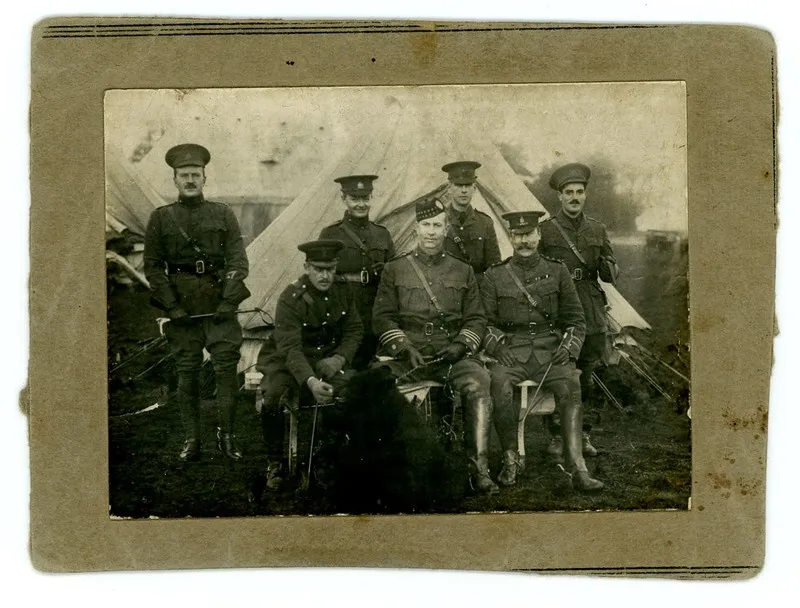 Photo: Harry Colebourn, via wardiaries.ca
A local trapper was selling a black bear cub at the station—its mother had been shot, leaving the tiny orphan in need of a home. Most soldiers would have walked past without a second thought. Colebourn, a veterinarian from Winnipeg, saw something different. For twenty dollars (roughly $500 today), he bought the cub and named her Winnie after his hometown.
What started as an impulsive act of animal rescue was about to become one of the most extraordinary military careers in Canadian history.
A Bear in Basic Training
When Colebourn arrived at the Valcartier military camp in Quebec with a bear cub in tow, his commanding officers faced an unprecedented situation. Military regulations covered everything from uniform standards to combat protocols, but nowhere in the manual did it address what to do when a soldier adopts a wild animal.
The solution was typically Canadian: they made it official. Winnie was formally enrolled as the regimental mascot of the Second Canadian Infantry Brigade. She received her own service number, appeared on military rolls, and was technically outranked only by the officers who fed her.
The bear took to military life with surprising enthusiasm. She learned to march in formation (sort of), slept in the barracks, and became the unofficial morale officer for homesick soldiers. Photographs from the period show Winnie wrestling with troops, sharing meals, and posing for formal military portraits with the dignity of a seasoned veteran.
Across the Atlantic with the Expeditionary Force
When the Second Canadian Infantry Brigade shipped out for England, Winnie went with them. She was listed on the transport manifest as "one bear (military mascot)" and assigned her own berth on the troop ship. Immigration officials at British ports had processed thousands of Canadian soldiers, but Winnie represented their first ursine immigrant.
At Salisbury Plain, where Canadian forces trained before deploying to France, Winnie became a celebrity. British newspapers ran stories about the "soldier bear" who could perform basic drills and had never missed a formation. She was photographed with visiting dignitaries and became a symbol of Canadian military spirit.
But as deployment to the Western Front approached, even the most creative military minds couldn't justify bringing a bear into trench warfare. Colebourn faced an impossible choice: abandon his companion or miss the war entirely.
A Temporary Home Becomes Permanent
In December 1914, Colebourn made the heartbreaking decision to leave Winnie at the London Zoo "for the duration of the war." He visited whenever he had leave, maintaining their bond even as he fought in some of the bloodiest battles in human history. Zoo records show that Winnie was officially listed as "on loan from Lt. H. Colebourn, Canadian Army Veterinary Corps."
 Photo: London Zoo, via lonelyplanetimages.imgix.net
What was supposed to be a temporary arrangement became permanent when Colebourn realized that Winnie had found her true calling. She had become the zoo's most popular attraction, beloved by thousands of visitors who came specifically to see the famous "soldier bear." Children would spend hours watching her playful antics, and she seemed to genuinely enjoy the attention.
In 1919, Colebourn made the ultimate sacrifice: he officially donated Winnie to the London Zoo, ensuring she would have a permanent home surrounded by the people who adored her.
The Boy Who Changed Everything
Among Winnie's regular visitors was a young boy named Christopher Robin Milne, who came to the zoo with his father, author A.A. Milne. Christopher Robin was enchanted by the gentle bear who would eat from children's hands and seemed to pose for photographs. He began calling his own teddy bear "Winnie" after his favorite zoo animal.
 Photo: A.A. Milne, via www.poetry.monster
A.A. Milne, watching his son's fascination with both the real bear and his stuffed companion, began crafting stories about a bear named "Winnie-the-Pooh." The first collection was published in 1926, featuring a honey-loving bear who lived in the Hundred Acre Wood with his friend Christopher Robin.
The books became instant classics, spawning a franchise that continues to generate billions of dollars in revenue nearly a century later. Disney's adaptations made Pooh a global icon, familiar to children in dozens of languages across every continent.
A Legacy Written in Honey and History
Winnie lived at the London Zoo until 1934, never knowing that her name had become synonymous with childhood itself. Harry Colebourn visited whenever possible, maintaining their friendship until her death. Zoo staff reported that she always recognized her original companion, becoming noticeably excited whenever he appeared.
The coincidences that created this story are almost too remarkable to believe. A chance encounter at a railway station led to a military mascot who inspired the world's most famous fictional bear. A veterinarian's impulse purchase during wartime accidentally launched a children's literature empire that has touched millions of lives.
From Trenches to Toy Stores
Today, statues of Winnie and Harry Colebourn stand in parks across Canada, commemorating their unlikely partnership. The original Winnie-the-Pooh toys are displayed at the New York Public Library, visited by thousands of pilgrims who want to see the stuffed animals that inspired A.A. Milne's stories.
Military historians still study Winnie's service record as an example of how morale-boosting innovations helped troops cope with the psychological trauma of World War I. She proved that sometimes the most effective military strategies involve compassion rather than combat.
The strangest part of this story isn't that a bear became a military mascot, or even that she inspired one of literature's most enduring characters. It's that a twenty-dollar impulse purchase by a homesick soldier accidentally created a cultural phenomenon that continues to comfort children around the world, proving that the smallest acts of kindness can have the most extraordinary consequences.
In the end, Winnie's greatest military victory wasn't won on any battlefield—it was the conquest of millions of young hearts, armed with nothing more than honey and imagination.