The Great Blackbird Blitz: When the US Government Went to War Against Birds and Got Humiliated
The Great Blackbird Blitz: When the US Government Went to War Against Birds and Got Humiliated
In 1959, the United States government made a decision that would go down as one of the most spectacularly misguided campaigns in federal history: they declared war on birds. Not metaphorically, not symbolically, but with actual military precision, chemical weapons, and a budget that could have funded a small space program.
The enemy? Red-winged blackbirds. The result? A humiliation so complete that officials spent decades pretending it never happened.
The Feathered Menace
To understand how things got so out of hand, you need to appreciate the scale of the problem facing American agriculture in the late 1950s. Red-winged blackbirds weren't just eating crops — they were devouring them with biblical efficiency.
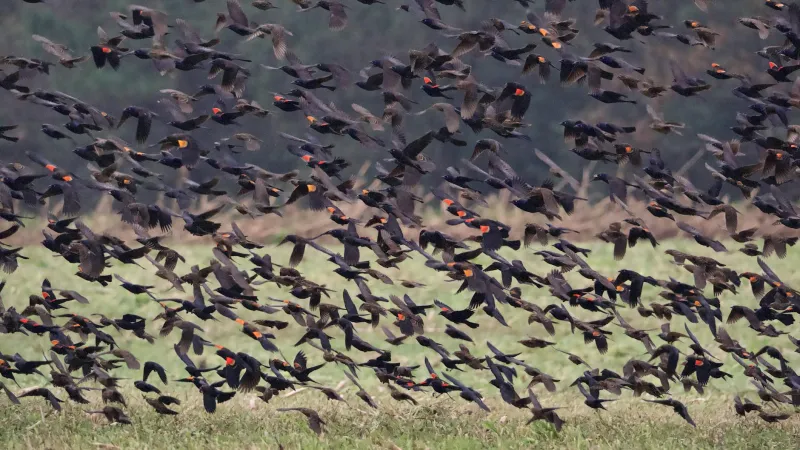
These weren't your garden-variety backyard birds. Red-winged blackbirds travel in flocks that can number in the millions, descending on rice fields, corn crops, and sunflower farms like living tornadoes. In Louisiana alone, agricultural officials estimated that blackbirds were destroying $25 million worth of crops annually — roughly $250 million in today's money.
Farmers had tried everything: scarecrows, noise makers, hunting, poison. Nothing worked. The birds adapted faster than humans could devise new deterrents. Worse, their population seemed to be exploding. What had once been a manageable nuisance had become an agricultural catastrophe.
Operation Blackbird
Enter the U.S. Department of Agriculture, flush with post-war confidence and armed with military surplus equipment. If farmers couldn't handle a bunch of birds, surely the federal government could. After all, they'd just won World War II and were putting satellites in space. How hard could it be to defeat some overgrown sparrows?
The USDA's plan was breathtaking in its scope and terrifying in its thoroughness. Officially dubbed "Blackbird Control Program," but known internally as "Operation Blackbird," the campaign would deploy every tool in the government's arsenal against the feathered menace.
Phase One involved aerial reconnaissance. Military aircraft equipped with cameras mapped blackbird roosting sites across the South, identifying targets for future operations. The maps looked like invasion plans because, essentially, that's what they were.
Phase Two brought in the heavy artillery: crop dusters modified to carry military-grade chemical dispersants. The plan was to saturate roosting areas with detergent-based solutions that would strip the natural oils from bird feathers, causing them to freeze to death during cold snaps.
Escalation and Desperation
When chemical warfare proved insufficient, officials escalated to explosives. Teams of federal agents began detonating dynamite charges in blackbird roosting areas, hoping to frighten the flocks into permanent relocation. The explosions were so frequent that local residents began complaining about the noise.
Next came the flamethrowers. Yes, flamethrowers. Federal agents armed with military surplus flame units began torching blackbird nesting areas, turning wetlands into temporary infernos. Environmental concerns weren't yet part of government decision-making, and officials saw no problem with setting marshes ablaze in pursuit of their feathered enemies.
When even flamethrowers failed to achieve decisive results, the program took a turn toward the truly bizarre. Scientists experimented with ultrasonic devices designed to drive birds insane with high-frequency noise. They deployed massive loudspeakers broadcasting predator calls. They even tested experimental hormones designed to disrupt blackbird reproduction cycles.
The Birds Fight Back
Throughout this escalating campaign, the blackbirds displayed an almost supernatural ability to adapt and survive. Flocks learned to avoid areas where aircraft had been spotted. They changed their roosting patterns to evade ground teams. Most frustratingly for officials, they seemed to be thriving under pressure.
Population counts conducted during the campaign showed that blackbird numbers weren't decreasing — they were actually increasing. The government's war was having the opposite of its intended effect. Stress from constant harassment appeared to trigger reproductive responses that boosted blackbird breeding success.
Worse, the birds began exhibiting behaviors that seemed almost deliberately vindictive. Flocks that had previously fed in random patterns started concentrating their attacks on farms near government facilities. Agricultural officials began receiving reports of blackbirds targeting crops with unprecedented precision, as if they knew exactly which fields would cause maximum economic damage.
The Quiet Retreat
By 1962, three years and an estimated $20 million into Operation Blackbird, even the most determined officials had to acknowledge reality. The program wasn't just failing — it was making things worse. Blackbird populations were higher than when the campaign began, crop damage continued unabated, and environmental groups were starting to ask uncomfortable questions about the government's war on wildlife.
The USDA quietly shuttered the program, transferring personnel to other projects and burying most documentation in bureaucratic archives. No press releases announced the end of Operation Blackbird. No officials gave interviews explaining what went wrong. The entire campaign simply... disappeared from official records.
Congress never held hearings about the failed program. No investigative journalists uncovered the story. The government's most expensive and unsuccessful wildlife control effort vanished into bureaucratic amnesia, leaving only scattered budget line items and a few embarrassed scientists who'd sworn never to speak of it.
Lessons Written in Feathers
The blackbird war taught valuable lessons that would reshape American environmental policy for decades. It demonstrated the futility of treating complex ecological problems with simple military solutions. It showed how little scientists understood about animal behavior and population dynamics. Most importantly, it revealed the dangers of bureaucratic overconfidence when confronting natural systems.
Operation Blackbird directly influenced the environmental legislation of the 1960s and 1970s. Scientists who witnessed the campaign's failures became advocates for ecological approaches to wildlife management. The program's spectacular ineffectiveness helped convince policymakers that nature required cooperation, not conquest.
Today, red-winged blackbirds remain a challenge for American agriculture, but they're managed through targeted, science-based approaches that work with natural systems rather than against them. The birds are still winning, but at least humans have stopped trying to fight them with dynamite.
Sometimes the most valuable victories are the wars we learn not to fight.