The Stranger in Uniform: When an American Soldier Became His Own Army's Most Wanted Enemy
The Vanishing Act
War has a way of changing people, but few transformations have been quite as literal — or legally problematic — as what happened to Sergeant Tommy Walsh in the autumn of 1918.
Walsh, a 23-year-old farm boy from Nebraska, had volunteered for one of the American Expeditionary Force's most dangerous assignments: a solo reconnaissance mission deep behind German lines in France's Argonne Forest. His job was simple in theory, terrifying in practice — slip through enemy territory, gather intelligence on German artillery positions, and return with information that could save hundreds of American lives.
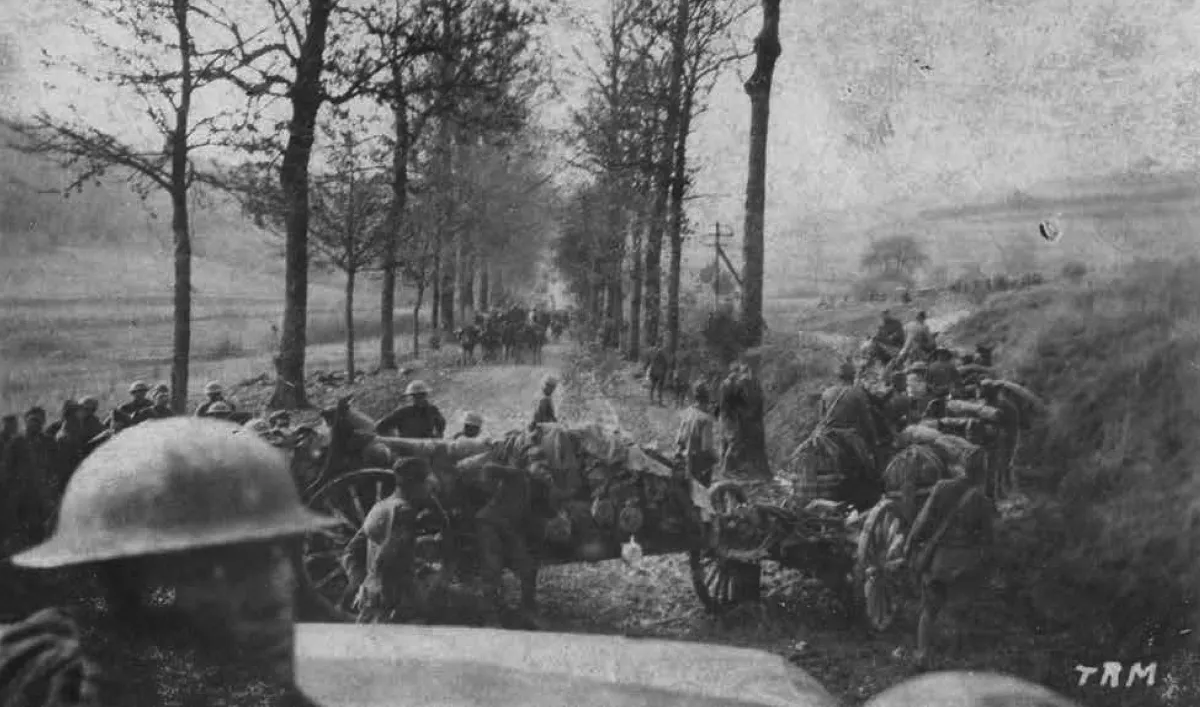 Photo: Argonne Forest, via i.redd.it
On October 12th, Walsh disappeared into the forest carrying nothing but a rifle, basic rations for three days, and orders to return within a week. His commanding officer, Colonel James Mitchell, expected him back by October 19th at the latest.
 Photo: Colonel James Mitchell, via www.honorflightchicago.org
October 19th came and went. So did the 20th, 21st, and 22nd. By Halloween, Walsh had been missing for nearly three weeks, and Mitchell had reluctantly filed the paperwork listing him as "Missing in Action, Presumed Dead."
That's when the stranger showed up.
The Unrecognizable Return
On November 2nd, an exhausted figure stumbled into the American camp just before dawn. The man wore a mixture of German and American uniform pieces, his face was hidden behind weeks of wild beard growth, and his skin had been burned dark brown by constant exposure to sun and weather. He claimed to be Sergeant Tommy Walsh, returning from his reconnaissance mission.
The problem? Nobody believed him.
The man standing before Colonel Mitchell bore virtually no resemblance to the clean-shaven, pale farm boy who'd left three weeks earlier. This stranger was twenty pounds thinner, spoke with what sounded like a slight accent, and carried German equipment that could have been looted from enemy casualties — or issued to a German spy attempting to infiltrate American lines.
"I'm telling you, Colonel, it's me — Tommy Walsh from Omaha," the stranger insisted. "You sent me out three weeks ago to scout artillery positions near Verdun."
Mitchell studied the man carefully. The voice sounded familiar, maybe, but voices could be mimicked. The stranger knew details about the mission, but German intelligence was sophisticated enough to extract that information from a captured soldier before sending in a replacement.
Most damning of all, the man carried no identification. His dog tags were gone, lost during what he claimed was a river crossing under enemy fire. His uniform had been so damaged that he'd replaced pieces with salvaged German gear. Even his rifle was a German Mauser he said he'd taken from a dead sniper.
"I'm sorry, son," Mitchell told the stranger, "but I'm going to need more proof than your word."
The Arrest
Within an hour, the man claiming to be Tommy Walsh found himself under armed guard, charged with espionage and impersonating an American soldier. Military police confiscated his mixed uniform and equipment, searching for hidden documents or coded messages that might reveal his true mission.
The charges were serious enough to warrant a court-martial, with execution as the likely outcome if convicted. German spies caught in American uniform were routinely shot, and this case seemed straightforward enough — an enemy agent had studied a missing American soldier's background and attempted to use that knowledge to infiltrate U.S. forces.
But the prisoner's story never wavered. During hours of interrogation, he provided increasingly specific details about his three weeks behind enemy lines. He described German artillery positions with military precision, sketched detailed maps of enemy fortifications, and recounted a harrowing tale of survival that included hiding in bombed-out buildings, stealing food from German supply convoys, and evading capture by enemy patrols.
Most convincingly, his intelligence proved accurate. When American artillery used his coordinates to target the positions he'd identified, they scored direct hits on previously unknown German gun emplacements.
The Military Justice Theater
The court-martial convened on November 4th in a converted farmhouse that served as the division's temporary headquarters. The prosecution's case seemed airtight: an unidentifiable man with German equipment, no valid identification, and a story too dramatic to believe.
Captain Robert Hayes, assigned as defense counsel despite never having met his client, faced an impossible challenge. How do you prove someone's identity when their own commanding officer doesn't recognize them?
Hayes' strategy was to focus on details that only the real Tommy Walsh could know — not just mission specifics that might have been extracted under torture, but personal information about his fellow soldiers, inside jokes, shared experiences that predated the reconnaissance mission.
"Tell me about Private Johnson's gambling debt," Hayes asked his client during testimony.
"Bobby Johnson owes Corporal Martinez fifteen dollars from a poker game three nights before I left," the prisoner replied. "He was trying to fill an inside straight and Martinez was bluffing with a pair of threes."
The courtroom murmured. Several soldiers confirmed the poker game had indeed happened, though they couldn't remember the specific details.
Hayes continued: "What did Colonel Mitchell say about his wife's cooking the morning you received your orders?"
"He said Martha's biscuits could stop German bullets better than our helmets, but don't tell her he said so because she thinks they're the best in Nebraska."
Colonel Mitchell shifted uncomfortably in his seat. The comment sounded familiar, but he made similar jokes about his wife's cooking all the time.
The Breakthrough
The trial might have ended in conviction if not for a moment of pure chance. On the second day of proceedings, as the prisoner was describing his escape from a German patrol, he let out a distinctive laugh — a high-pitched, almost musical chuckle that seemed completely at odds with his weathered appearance.
Colonel Mitchell's head snapped up. He'd heard that laugh a thousand times during training exercises, around campfires, in the mess tent. It was unmistakably, uniquely Tommy Walsh's laugh — a sound so distinctive that Walsh's fellow soldiers had nicknamed him "Songbird" because of it.
"Dear God," Mitchell whispered, loud enough for the entire courtroom to hear. "Tommy? Is that really you?"
The prisoner grinned — and suddenly, despite the beard, the sunburn, and the dramatic weight loss, Colonel Mitchell could see traces of the young farmer from Nebraska he'd sent into the forest three weeks earlier.
The Anticlimactic Resolution
Once Mitchell's recognition broke the spell, other soldiers began seeing familiar features beneath Walsh's transformed appearance. His distinctive way of gesturing when telling stories, his habit of rubbing his left ear when nervous, small mannerisms that no German spy could have learned or replicated.
The court-martial was hastily dismissed. Walsh was officially reinstated to his rank and commended for his successful reconnaissance mission. His intelligence proved so valuable that it contributed to a major American offensive that helped shorten the war.
But the psychological impact lingered. Walsh later admitted that being arrested by his own army was more terrifying than anything he'd experienced behind enemy lines. "I expected the Germans to shoot me," he told reporters after the war. "I never thought my own people would."
The Lesson in Recognition
Walsh's case became a cautionary tale about the assumptions we make based on appearance and the dangers of rigid thinking in chaotic situations. Military protocols were updated to include better procedures for verifying the identity of soldiers returning from extended missions.
More broadly, the incident highlighted how war transforms people in ways that go far beyond physical appearance. The Tommy Walsh who returned from the Argonne Forest was fundamentally different from the young man who'd volunteered for the mission — not just in looks, but in bearing, confidence, and worldliness.
His own commanding officer's failure to recognize him wasn't just about sunburn and facial hair. It was about the psychological distance between the innocent farm boy who'd left camp and the hardened survivor who'd returned.
In the end, it took Walsh's distinctive laugh — something uniquely, unchangeably his — to bridge that gap and prove that sometimes the most unbelievable truth is that people can become completely different versions of themselves while remaining fundamentally who they've always been.